Here is your chance to see what an English lesson at Maltalingua is really like.
This blog takes you to Malta and drops you into one of our classrooms, sitting in on an adult English lesson with the B1 class.
Here are some insights into an English lesson at Maltalingua
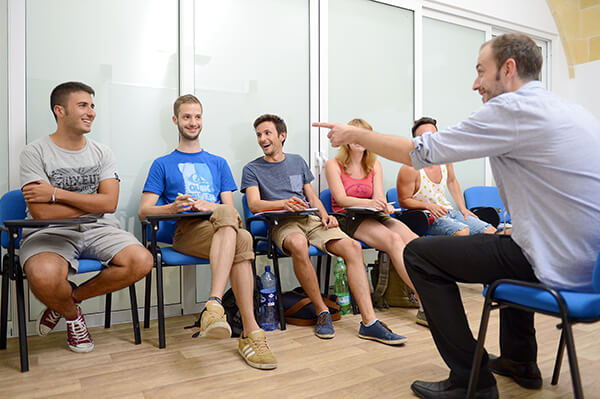
Conversations and group work:
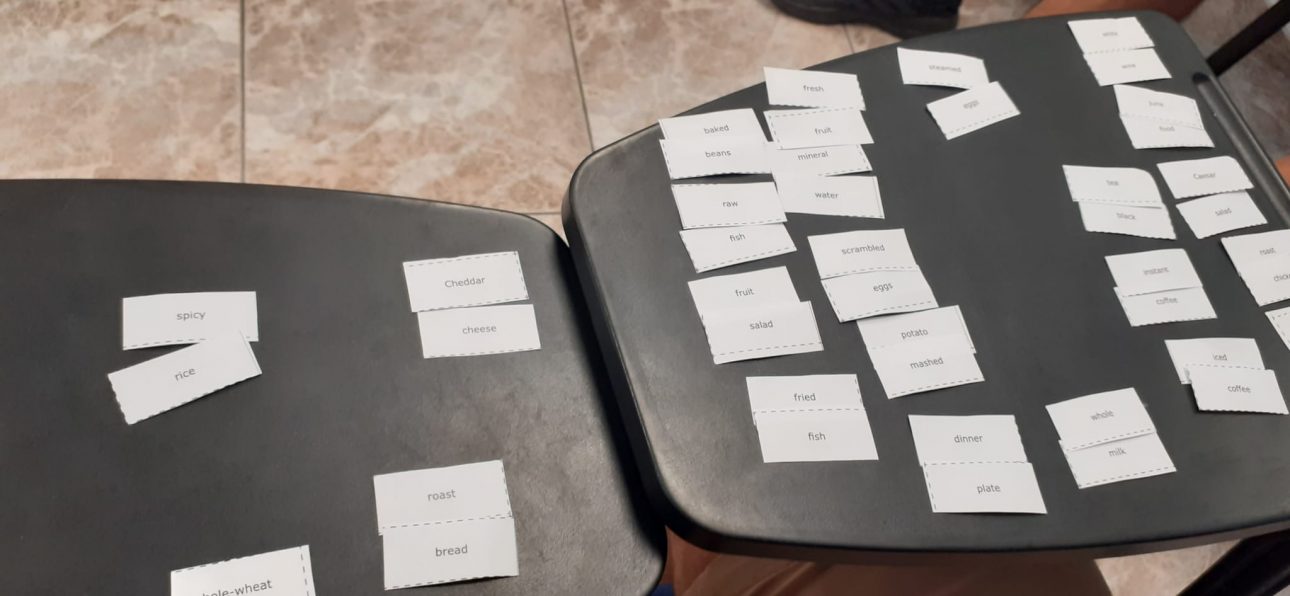
A few students were already in the classroom before nine in the morning, waiting for the teacher. Once all 12 had arrived, the lesson got underway. To warm everyone up, the class started with a group activity called “Food and Drink collocation dominoes”.
Students worked in groups of three, picking out two word halves that pair up to make a single collocation from a larger set of mixed halves.
Take “Caesar” and “salad”, or “white” and “wine”. The teacher went through everyone’s answers on the whiteboard and corrected them. Since the theme was food, the corrections turned into a discussion. Questions like “What are baked beans?”, “Who likes raw fish?”, “Who has tried spicy curry?” and “How do you make mashed potatoes?” got everyone talking. People shared a little about their favourite foods and got to know each other, which made for a really warm atmosphere. A few of the students’ sentences went up on the whiteboard along the way, so the grammar could be checked later.
Grammar
After 1.5 hours of lessons came a thirty minute break. The second half of the morning moved on to grammar: the second conditional.
The second conditional is used to talk about possible or imagined situations. It has an “if clause” and a “consequence or result clause”. For the full sentence, you use “if” + a subject + a verb in the past, then “would”, “could”, or “might” + an infinitive in the other half. The consequence clause spells out the imagined result.
You use these sentences for situations that cannot be changed, or that are not going to happen. That is enough theory, though. Next came a few examples and some exercises to practise.
Examples:
If you weren’t on a diet, you wouldn’t be so hungry now.
If you weren’t hungry now, you wouldn’t have to eat chips.
Exercises:
A few exercises were lined up to put the theory into practice. In the first, students chose the right verb forms to make each sentence grammatically correct. The second asked them to fix some incorrect sentences. After that, the class played an online game where everyone signed in on their phones. For each sentence they picked from a set of options to complete it, but only one was right. One example sentence was: “Andrea…a colour, she…pink.” The choices for the two gaps were: “Was, would be”, “Is, would”, and “would be, is”. At the end, the top 3 students were announced.
So now you have a sense of how lessons at Maltalingua work. We run all kinds of classes across all the different levels, so there really is a course to suit everyone.
Explore our English courses or request a free quotation, so you can improve your English here at Maltalingua.
Alternatively, read more of our blogs and keep yourself updated with everything Maltalingua.